This website is intended only for patients in the UK who have been prescribed Gestone®

I want to know more about Gestone®
(progesterone for injection)
This information is provided by the marketing authorisation holder to support administration of Gestone® following prescription from your specialist/healthcare professional; always follow the instructions and guidance given to you by your healthcare professional and please refer to them if you have any questions.
It is important to read the product package leaflet provided with your medicine. This information is not a substitute for the product package leaflet. The package leaflet contains additional important information on the use of the medicine.


What is Gestone®
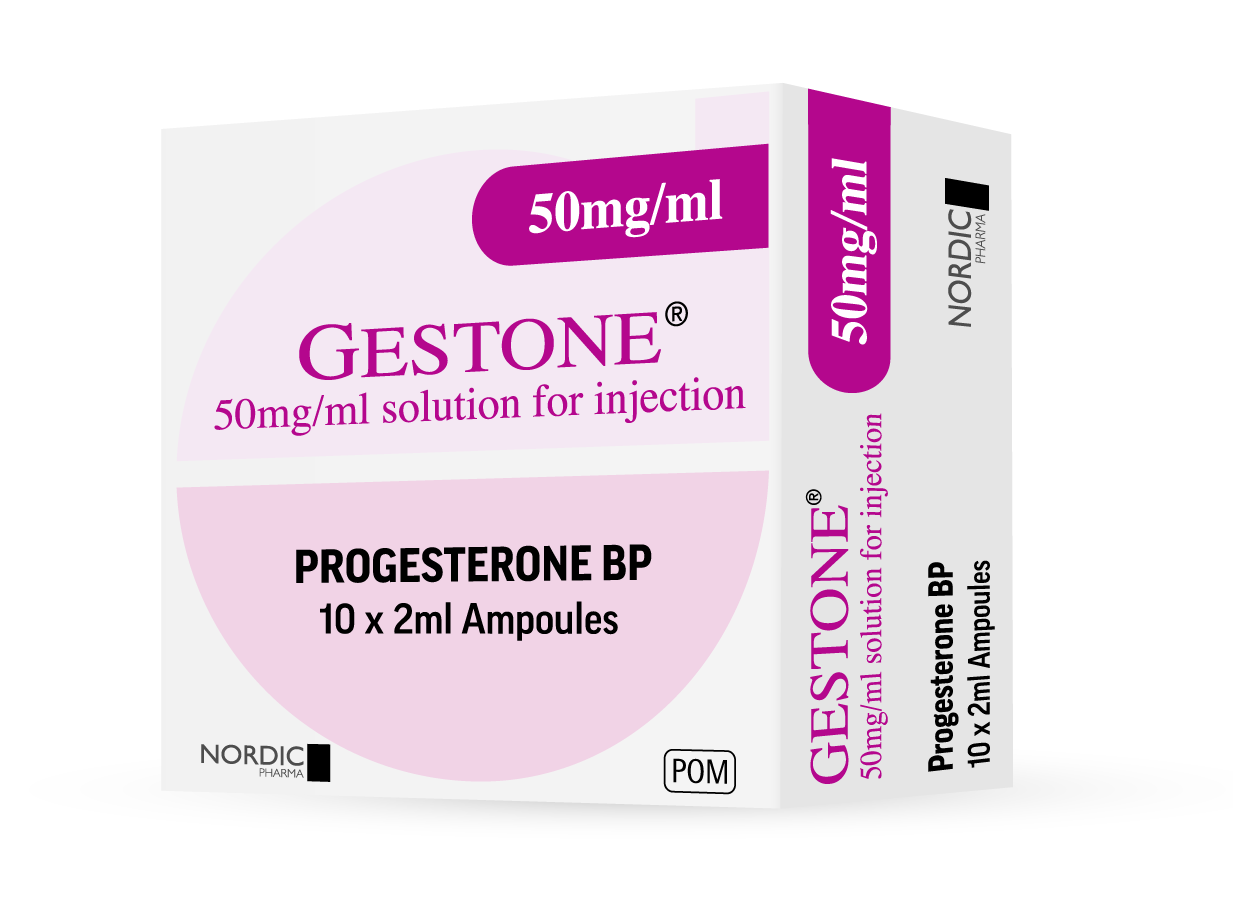
Gestone® is an intramuscular injection that contains progesterone.1,2 Progesterone is a hormone produced by the body during a typical menstrual cycle and during pregnancy to maintain the lining of the uterus.2,3
What is the role of progesterone?
The progesterone levels rise in the second half (“luteal phase”) of a typical menstrual cycle when a follicle in the ovary becomes a corpus luteum (CL) after it releases an egg. It is the CL that produces progesterone, to promote thickening of the endometrium in preparation to receive a fertilised egg. If implantation does not occur, progesterone levels fall and the endometrium thins, with the endometrial cells shedding during menstruation.4,5
If implantation does occur, progesterone remains high to maintain the thickened endometrium to support implantation and nourishment of the growing embryo as well as preventing endometrial shedding and uterine contractions. These functions help to maintain the pregnancy.3
In the early weeks of pregnancy, progesterone continues to be produced by the CL in the ovary. From about week 10, the placenta takes over.3 Gestone® is usually prescribed for 8–16 weeks, and your specialist will decide what is the appropriate length of time for you to ensure your progesterone level is adequate until placental progesterone production is established.1


Why have I been prescribed Gestone®?
Gestone® can be prescribed for women who are undergoing assisted reproductive technology (ART), such as in vitro fertilisation (IVF).1,2 In IVF cycles, where normal hormones are switched off, the usual menstrual cycle is disrupted and may mean that the corpus luteum (CL) does not produce enough of the progesterone needed to support the endometrium.4,5,6 Gestone® is prescribed to supplement your natural production and help ensure you have an appropriate level of progesterone.1,2
Gestone® may also be prescribed to women to help early pregnancy to continue in cases where the body is not producing enough progesterone, where there have been 3 or more unexplained miscarriages, and for the treatment of dysfunctional uterine bleeding.1,2
Correct administration of Gestone®
Gestone® is given as an intramuscular injection, injected deep into the buttock.
A video on the correct injection technique with Gestone® can be found below.

How frequently will I need
to administer Gestone®?
Read more
To support pregnancy, Gestone® will usually be administered between 2 and 7 times per week. Your specialist will decide the most appropriate dose and frequency for you, and you should always follow the directions they have given.
Treatment will normally begin from approximately day 15, or the day of your embryo or gametes transfer, and continue until Week 8–16 of your pregnancy.1 After this, and following successful implantation, your placenta will take over and begin to secrete its own progesterone.3 If you have any questions about the frequency of your Gestone® injections, please contact your clinic or specialist.
If you have been prescribed Gestone® for dysfunctional uterine bleeding, Gestone® should be taken for 5-10 days, up until 2 days before the anticipated onset of menstruation.1

What is the correct dose of
Gestone® for me?
Read more
When prescribed to support pregnancy, the dose of Gestone® may vary depending on what your doctor thinks is best for you, and is typically between 25–100 mg. In some cases, you may be prescribed a higher dose of up to 200 mg.
When prescribed for dysfunctional uterine bleeding, the does of Gestone® is 5–10 mg daily for 5–10 days, up until 2 days before anticipated onset of menstruation. If you have any questions about the dose of your Gestone® injections, please contact your clinic or specialist.

How do I inject
Gestone®?
Read more
Gestone® is given by injection deep into the buttock. Your doctor or nurse will train you in the correct injection technique and help you gain confidence. You will have the opportunity to ask any questions you may have. Following this, Gestone® is often administered within the comfort of your own home.
The video below demonstrates how to inject Gestone® correctly and safely at home. It is important to follow the correct injection technique to ensure you are getting the most out of your treatment. If you have any additional queries regarding the injection technique with Gestone®, please contact your clinic or specialist.

What to expect with Gestone®
Frequently asked questions
Why have I been prescribed Gestone®?
Why have I been prescribed Gestone®?
In IVF cycles, where normal hormones are switched off, the usual menstrual cycle is disrupted and may mean that the corpus luteum (CL) does not produce the progesterone it otherwise would. As pregnancy progresses, the placenta takes over progesterone production.3,6 Gestone® is prescribed for the earlier weeks of pregnancy to help ensure you have adequate progesterone levels until placental progesterone production is established.4 Gestone® may also be prescribed to help early pregnancy to continue in cases where the body is not producing enough progesterone, where patients have experienced 3 or more unexplained miscarriages, and for the treatment of dysfunctional uterine bleeding.1,2
Is the use of Gestone® new in Assisted Reproductive Technology?
Is the use of Gestone® new in Assisted Reproductive Technology?
Gestone®, and other medications containing progesterone, have been used as part of assisted reproductive technology (ART) programmes for many years and clinics have a great deal of experience in using them.7
What should I do if fragments of glass get into the ampoule when I open it?
What should I do if fragments of glass get into the ampoule when I open it?
Discard the ampoule: empty the contents into a tissue and put the used tissue and the empty ampoule into the sharps bin. Then start the injection process again using a fresh ampoule. Ensure you do not touch the raw edge of the ampoule or any glass fragments.
What should I do if I or my partner cut ourselves accidently while opening the ampoule?
What should I do if I or my partner cut ourselves accidently while opening the ampoule?
Clean any cut with an injection wipe and cover with a suitable plaster before proceeding.
What type of needle should be used for the injection?
What type of needle should be used for the injection?
Injection needles are available in different sizes depending on the type of medication and the site of the injection. Your clinic will have provided the appropriate needles for you to administer Gestone®. You should always use the supplies advised by your clinic.
What do I do if the sharps bin is full?
What do I do if the sharps bin is full?
Contact your clinic, homecare provider or pharmacist. They will advise you how to dispose of the full sharps bin and how to obtain a new, empty one. You are advised to do this before the bin is completely full.
What happens if there is blood in the syringe?
What happens if there is blood in the syringe?
Once the needle is inserted at the injection site, pull the plunger back a little to make sure that the needle has not hit a blood vessel. If you see blood come into the syringe, remove the needle immediately and do not inject.8 Discard the needle and syringe and start again by opening another ampoule and drawing it up into a new syringe, using a new needle. If this happens, choose a different injection site on the other side for the new injection.
Is a Gestone® injection painful?
Is a Gestone® injection painful?
Gestone® is an oil-based injection that is administered into the gluteal (buttock) muscle, and you may experience some discomfort.1,9 Please contact your clinic if you have any concerns.
What should I do if the skin around the injection gets sore and inflamed?
What should I do if the skin around the injection gets sore and inflamed?
A small amount of pain or redness is not unusual after an intramuscular injection.9 Your clinic can advise how best to manage them if you are experiencing discomfort. You should seek advice from your clinic before taking any medication that has not been prescribed for you.
What if I feel unwell after an injection?
What if I feel unwell after an injection?
If you have any concerns, please contact your clinic or specialist.
What should I do if I run out of Gestone®?
What should I do if I run out of Gestone®?
Your clinic will tell you how, and when, to request supplies of Gestone®. You are advised to contact them in plenty of time before the supplies you have run out so that you are not left without. This also applies to equipment such as needles and syringes required to administer the Gestone®. If you do run out or have any other questions or concerns about receiving supplies, please contact your clinic.
References
- Gestone® Summary of Product Characteristics. 2023.
- Gestone® Patient Information Leaflet. 2023.
- Cable JK, Grider MH. Physiology, Progesterone. May 2023. Available at: https://www.ncbi.nlm.nih.gov/books/NBK558960/. [Accessed November]
- Jain M, Singh M. Assisted Reproductive Technology (ART) Techniques. June 2023. Available at: https://www.ncbi.nlm.nih.gov/books/NBK576409/. [Accessed November 2023].
- Netdoctor. Gestone® (progesterone). Available at: https://www.netdoctor.co.uk/medicines/a8721/gestone-progesterone/. [Accessed November 2023].
- Duncan WC. Reproduction and Fertility. The Inadequate Corpus Luteum. February 2021. Available at: https://raf.bioscientifica.com/view/journals/raf/2/1/RAF-20-0044.xml. [Accessed April 2024].
- Labarta E, et al. Progesterone Use in Assisted Reproductive Technology. 2020. Available at: https://www.sciencedirect.com/science/article/pii/S1521693420300821?via%3Dihub. [Accessed November 2023].
- CIA Medical. How to Aspirate a Needle Before an Injection (And Why It’s Done). Available at: https://www.ciamedical.com/insights/how-to-aspirate-a-needle/. [Accessed November 2023].
- Pharmacy Times. Injection-Site Reactions and How to Manage Them. Available at: https://www.pharmacytimes.com/view/injection-site-reactions-and-how-to-manage-them. [Accessed November 2023].
Reporting of side effects

Privacy Policy
You are now leaving the website. The Nordic Pharma privacy policy can be found on the Nordic Pharma website.
For healthcare professionals only
I confirm that I am a healthcare professional.
Video transcript
00:00
This video is for people who have been prescribed Gestone and is designed to help you make sure the injections are administered as directed. It is important to read the product package leaflet provided with your medicine. The information in this video is not a substitute for the product package leaflet.
00:21
Your clinic will have shown you how the Gestone injections should be given and we recommend that you follow those directions. This video is intended to remind you of the steps you need to follow but please contact your clinic if you have any questions about the process or about your treatment.
00:39
Gestone is supplied in packs of 10 ampoules. Your clinic or pharmacy will provide you with the appropriate supplies of Gestone and the equipment you need depending on your personal treatment programme, and will explain how to access additional supplies when you need them. First, make sure you have all the equipment you need for the injection.
01:00
Gestone ampoule, ampoule opener or cutter if you use one, drawing up needle, injecting needle, syringe, sharps bin, and alcohol wipe. First, the person giving the injection should wash their hands with soap and water and dry them thoroughly.
01:19
On a clean surface, open the packet containing the drawing up needle. Use the colour needle as directed by your clinic. Taking care not to touch the metal part, handle the needle by the coloured plastic at its base and attach it to the syringe.
01:38
Flick the top of the ampoule to ensure that all the solution is in the bottom. Snap open the ampoule either using a snapper or cutter, if you have one, or with your forefinger and thumb. Use a tissue to protect your fingers and ensure you don’t touch the cut surface of the ampoule.
01:57
Holding the syringe, immerse the drawing up needle in the liquid inside the ampoule and withdraw the syringe plunger so that all the Gestone liquid is drawn up into the syringe. Remove the needle by holding it at its base and attach the needle you will use for the injection. Use the type of needle your clinic has recommended.
02:19
Hold the syringe with the needle facing upwards and tap the side of the syringe so that any small air bubbles rise to the top. Push the plunger gently to remove the bubbles. It is recommended to inject into the buttock muscle, and you should follow the guidance your clinic has given you.
02:38
Next, open the alcohol wipe and use it to wipe the skin in the area where the injection will be given. Let the skin dry. Do not touch this area of skin until you are ready to give the injection. With your free hand, gently pull the skin in the area where you will give the injection so that it is slightly tight.
03:00
Hold the syringe barrel with the other hand and press the needle through the skin and into the muscle at 90 degrees, until the needle is fully inserted. Let go of the skin with the other hand and hold the syringe so it stays at 90 degrees to the skin’s surface.
03:19
Pull the plunger back a little to make sure that the needle has not hit a blood vessel. If you see blood come into the syringe, remove the needle immediately and do not inject. Discard the needle and syringe and start again by opening another ampoule and drawing it up into a new syringe, using a new needle.
03:42
Push down on the syringe plunger. As Gestone is an oily injection, the liquid is thicker than water and the plunger will go in slowly. Once the syringe is empty, remove the needle. It is important to dispose of your needles and syringes correctly.
04:01
Your clinic will have provided you with a sharps bin, and you should dispose of the used needle, syringe and ampoule by putting them in it and ensuring that all parts are enclosed in the bin and there is nothing sticking out. Your clinic will explain how the sharps bin will be collected and replaced once full or you have completed treatment.
04:22
Never put needles or used ampoules in the normal rubbish. We hope you found this video helpful. It is intended to act as reminder of the steps to administer Gestone correctly, but your clinic will have shown you the recommended technique and you are reminded to contact them if you have any questions or concerns.

Transcript in English
For UK patients that have been prescribed Gestone®
The information on this site is intended for patients in the UK who have been prescribed
Gestone® and healthcare professionals
If you are a patient prescribed Gestone® in the UK or a healthcare professional, please
If you are not a healthcare professional or patient prescribed Gestone® but would like further information, please refer to the Summary of Product Characteristics (SmPC) and Patient information leaflet (PIL) linked below.